 |

Mongolia first became recognized as an entity under the mighty statesman and warrior, Chinggis Khaan. He united all the feudal clans into a powerful nation, which swept over Asia in the 13th century and created a vast empire. 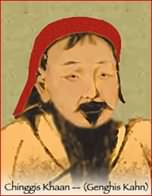 Most of what we know about the Mongol Empire comes from "The Secret History of the Mongols", composed in 1240. Temujin, mainly known to Westerners by valorous title of Chenghis Khan, was born 1162. Until 1206 he had been struggling for unity of Mongolian tribes and was given the honorary name "Chinggis Khaan." Some historians say that the name Chinggis come from Mongolian Shamanism meaning powerful spirit whereas others say that it is from the word 'Tengis' meaning sea. The Mongol Empire reached its greatest after Chinggis Khaan's death, when his son Ogedei Khan continued further military activities. The Empire reached Hungary to the west, Korea to the East, Siberia to the north and Vietnam in the south. Under the rule of his son, Khubilai Khaan, Chinese-based Great Mongol Empire collapsed in 1368 and crumbled. Most of what we know about the Mongol Empire comes from "The Secret History of the Mongols", composed in 1240. Temujin, mainly known to Westerners by valorous title of Chenghis Khan, was born 1162. Until 1206 he had been struggling for unity of Mongolian tribes and was given the honorary name "Chinggis Khaan." Some historians say that the name Chinggis come from Mongolian Shamanism meaning powerful spirit whereas others say that it is from the word 'Tengis' meaning sea. The Mongol Empire reached its greatest after Chinggis Khaan's death, when his son Ogedei Khan continued further military activities. The Empire reached Hungary to the west, Korea to the East, Siberia to the north and Vietnam in the south. Under the rule of his son, Khubilai Khaan, Chinese-based Great Mongol Empire collapsed in 1368 and crumbled. 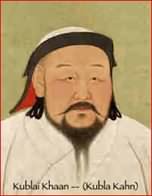 Feudalism dominated Mongolia and China again until the 16th century, when Altan Khan introduced the Mongolian nation to Tibetian Lamaistic Buddhism. Feudalism dominated Mongolia and China again until the 16th century, when Altan Khan introduced the Mongolian nation to Tibetian Lamaistic Buddhism.
During the 17th century, the Manchu Empire tried to suppress the Mongolian people and rule the country under the influence of Buddhism, but this was overturned in 1911 by the theocratic government of Bogd Khan, the 8 th living Buddha. In 1921, the People's Revolution, led by Sukhbaatar, subdued the country under one of the world's most oppressive Marxist regimes for 70 years. During this time there was little contact with the outside world, with the exception of the USSR. The Stalinist purges of this period broke the power of the monastic rule and the powerful monasteries became museums.
In 1990, a peaceful democratic revolution changed the whole system of government and the country is now open to the Western World. In its path to democracy and free market economy, Mongolia is experiencing an economic boom, with increasing volumes of international trade. New technology and fashion is coming into the country at a rapid rate, but is being adopted in the context of the traditional Mongolian way of life-hospitality, nomadism and lamaistic buddhism.
Marco Polo in Mongolia
When Chingiz Khan died in 1227 the Mongol army had already overrun Central Asia, was in northern Persia and had penetrated deeply into China. A vanguard of the army was in Eastern Europe. Italian merchants trading along the Black Sea coast willingly gave the Mongol army a wealth of intelligence about European states and their leaders. 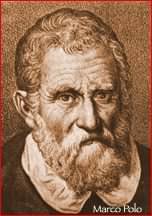 One result of the ties with Italy was the travels of Marco Polo. One result of the ties with Italy was the travels of Marco Polo.
Marco Polo (1254-1324), is probably the most famous Westerner traveled on the Silk Road. He excelled all the other travelers in his determination, his writing, and his influence. His journey through Asia lasted 24 years. He reached further than any of his predecessors, beyond Mongolia to China. He became a confidant of Kublai Khan (1214-1294). He traveled the whole of China and returned to tell the tale, which became the world's first great travelogue.
His account of China inspired other Europeans, including Columbus, to both interest and greed. Serious questions have always been raised about the authenticity of the text. Some scholors have pointed out that much of Polo's vocabulary is Persian rather than Chinese, and suggested that he got only as far as Persia. Others have noted that he omits descriptions of certain aspects of Chinese life which would seem unmissable - the Great Wall of China for instance.
Fra Jacopo d'Acqui, a contemporary of Marko Polo and his first biographer, described Marko's words at his death bed, one winter day in January 1324. When the priest, and Marko's relatives and friends asked him to refute finally all those countless lies which he presented as his real adventures, Marko Polo raised himself from the bed, rebuked them and said: "I have not told you the half of what I had experienced because I knew that you would not believe me."
Facts About Mongolia
Mongolia is the country with the highest number of horses per capita.
Mongolia was the first nation in the world to introduce paper money.
In Mongolia, before the Communist purge of 1929-1937, there were more than 700 monasteries with more than 100,000 monks.
After the Communist purge, no monks were left and only six temples remained undestroyed. The monks were killed, imprisoned, exiled, or forced to join the army or the laity.
Nostradamus predicted the rebirth of Chinggis Khaan in Mongolia in 2000, thus bringing back all the lost power of Mongolia and its control over the world. It's too soon to know, but many in Mongolia would welcome Chinggis Khaan in hope that problems could be solved and that he would bring lots of good things to Mongolia--to the world perhaps. Who knows?
The fourth Dalai Lama, Yondon Jamts ( 1589-1616 ), was a Mongolian. He was born as a grandson of the Mongolian King Altan
Khaan and was given perfect knowledge and very special care until he died in a monastery at Braivan, Central Tibet.
The following words are derived from Mongolian:
- Moscow ( "mushgia"-twisted or spiral );
- Siberia ( "shirenge"-grove );
- Kremlin ( "kherem"-fortification );
- Embassy ( "amban saida"-high minister );
- Baikal ( "baigal"-nature );
- Dalai Lama ( "dalai"-ocean )
Sakya lama, the Buddhist teacher to Khubilai Khaan, saved the world's religions. After installing Sakya Lama as the State
Teacher, Khubilai Khaan told him that he was going to destroy all other religions, including Christianity and Islam, so that the Mongolia Empire would have only one religion-Buddhism. Sakya Lama advised against this plan, claiming that people have to become Buddhists only if they wish to be Buddhists, but not by force. It's a concept some of today's religions could embrace.
Some say one of the Eight Wonders of tne World, the Taj Mahal, was built by a Mongolian King. Indian historians still assert that the Mogol Kingdom had a Mongolian origin. Even now you can see Mongolian names like "Esonzev" ( nine knives ) at the wall of the Kings Palace which is 5 km from the Taj Mahal. The shape of wall of the Palace is reminiscent of Mongolian ger decorations.
|
