|
|
GEOGRAPHY of the REGION
The Yukon ~ Land of Far North America. The Yukon Territory in Canada's northwest is generally divided into two broad geographical regions, taiga and tundra.
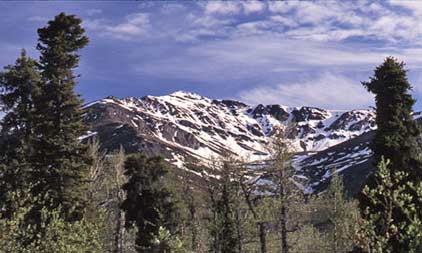 Taiga
Taiga
The taiga or boreal forest exists as a nearly continuous belt of coniferous (needle leaf) trees across North America and Eurasia. Overlying formerly glaciated areas and areas of patchy permafrost on both continents, the forest is a mosaic of plant communities. Taiga is the Russian name for this forest which covers so much of that country. However, the term is used in North America as well. Long, severe winters up to six months with mean temperatures below freezing, and short summers are characteristic with a wide range of temperatures between the lows of winter and highs of summer.
Taiga soil tends to be young and nutrient-poor. The thinness of the soil is due largely to the cold. It hinders the development of soil, as well as the ease with which plants can use its nutrients. Fallen leaves and moss can remain on the forest floor for a long time in the cool, moist climate, which limits their organic contribution to the soil. Acids from evergreen needles further leach the soil. Since the soil is acidic due to the falling needles, the forest floor has only lichens and some mosses growing on it. It is not good for farming because it is nutrient poor.
Black and white spruces are the most common conifers. Taiga trees tend to have shallow roots to take advantage of the thin soils, while many of them seasonally alter their biochemistry to make them more resistant to freezing, called "hardening". The narrow conical shape of northern conifers, and their downward-drooping limbs, also help them shed snow.
Tundra
The word tundra derives from the Finnish word for barren or treeless land. The tundra is the simplest biome in terms of species composition and food chains.
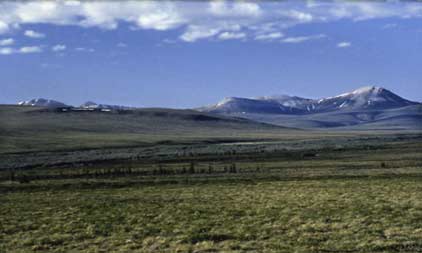 Tundra encircles the Arctic Polar regions and extends south to the coniferous forests of the taiga. Tundra is known for its cold desert-like conditions. The growing season ranges from 50 to 60 days. The average winter temperature is -34 degrees F. but the summer temperature of 37-54 degrees F. enables the tundra to sustain life. Soil is formed slowly. A layer of permanently frozen subsoil of gravel and fine material called permafrost exists. When water saturates the upper surface, bogs and ponds may form, providing moisture for plants. There are no deep root systems in the vegetation of the arctic tundra, however there are still a wide variety of plants that are able to resist the cold climate. All of the plants are adapted to sweeping winds and disturbances of the soil. Plants are short and group together to resist the cold temperatures and are protected by the snow during the winter. They can carry out photosynthesis at low temperatures and low light intensities. The growing seasons are short and most plants reproduce by budding and division rather than sexually by flowering.
|
|
| |
|